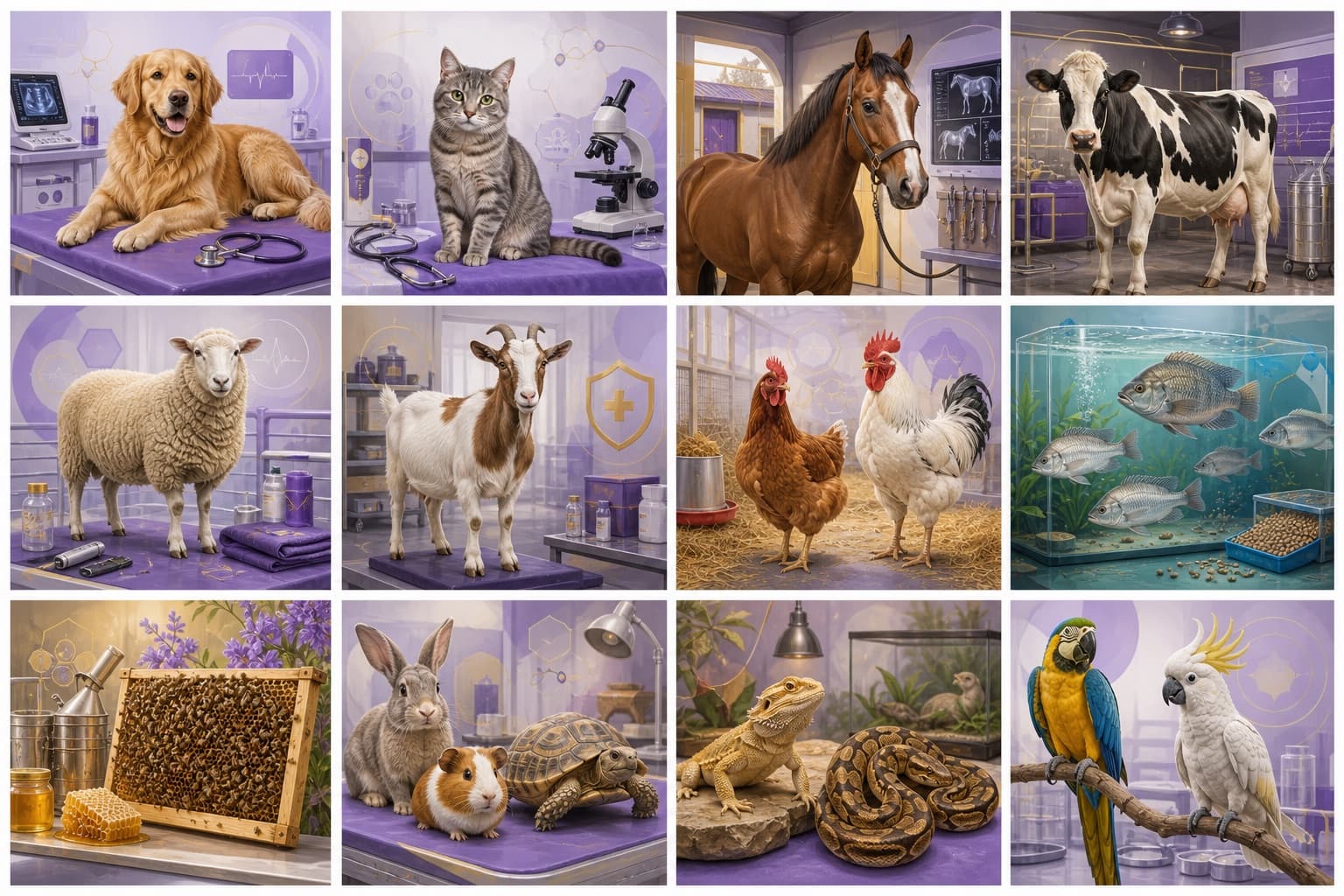
Ferrets, guinea pigs, hamsters, chinchillas, hedgehogs, and sugar gliders each have very different needs. This hub teaches small-companion health, nutrition, housing and enrichment, reproduction, neonatal care, biosecurity, welfare, and emergency readiness — for owners, rescues, educators, breeders, students, and veterinary teams.
All numbers are computed from the live course catalog — nothing is estimated or invented.
Learning domains
Ten small-companion domains, one honest status system
Published curricula show their real module and lesson-plan counts. Nothing is marked available until real lessons exist — no invented ratings, student counts, or completion data.
Curriculum readyComing soon
Curriculum readyPremium
NAC Health & Disease Prevention
A prevention-first VetSoul course for new companion animals health baselines, disease warning signs, biosecurity, parasite or pathogen awareness, welfare monitoring, and urgent response.
A practical VetSoul course for feeding new companion animals by life stage, health status, environment, behavior, production goals, and species-specific nutrition needs.
A VetSoul course for understanding new companion animals reproductive biology, breeding readiness, environmental planning, birth or hatch preparation, and early young companion animal viability signals.
An ethical new companion animals breeding course for selection goals, health screening, records, housing, environmental standards, placement decisions, and welfare safeguards.
A foundational course for young companion animal care, early environment setup, feeding support, growth monitoring, hygiene, social development, and early warning signs.
A calm, practical first-aid course for recognizing urgent new companion animals problems, stabilizing safely, isolating affected animals, and communicating clearly with veterinary or specialist support.
Every New Companion Animals Academy pathway follows the same practical arc, so learners always know where a lesson sits and where their own responsibility ends.
1
Species foundations
Normal baselines per species — a ferret, a guinea pig, and a hamster differ in diet, activity, temperature, and lifespan.
2
Prevention
Enclosure hygiene, quarantine of new animals, diet-related disease prevention, and biosecurity between animals.
3
Observation
Structured checks: appetite, droppings, weight, coat, and records that reveal change early in small prey species that hide illness.
4
Decision-making
Turning observations into calm decisions: what can wait, what needs a husbandry change, and what needs help now.
5
When to seek veterinary care
Not eating, laboured breathing, dental overgrowth, wet tail, or sudden weakness — thresholds where the right decision is an exotics-savvy veterinarian.
Veterinary tools
Small-companion tools, built with veterinary review
Practical tools are being built alongside the curricula — and they will only ship after veterinary review. No formula on VetSoul will ever be published unverified.
Coming soon
Weight & condition log
Structured weight and body-condition records — the earliest signal of illness in small companions.
Quarantine & husbandry calendar
New-animal quarantine timelines and species-specific husbandry checkpoints.
Species diet worksheet
Feeding structure support connected to the Small Companion Nutrition curriculum.
Responsible AI support for small-companion learners
VetGPT Coach is an educational assistant, not a diagnosis engine. In small-companion mode it supports safer questions, species-specific husbandry and quarantine planning, and course review — and always keeps your exotics-savvy veterinarian in the loop.
Species-aware study prompts for ferret, rodent, and glider health and nutrition
Prevention and quarantine planning before introducing or moving small companions
Red-flag literacy: not eating, laboured breathing, dental overgrowth, and wet-tail thresholds, education only
Course review support connected to New Companion Animals Academy curricula
Emergency language — not eating, laboured breathing, wet tail, sudden weakness — always redirects to an exotics-savvy veterinarian, and zoonotic risks to safe hygiene practice.
Course-aware
Prompts connect to the published New Companion Animals Academy curricula.
Species-specific
Ferret, rodent, and glider physiology and husbandry context — never one-size-fits-all pet advice.
Responsible breeding
Breeding education with welfare before output
The New Companion Animals Academy treats breeding as a responsibility, not just production. Two published curricula cover the full arc from reproductive literacy to neonatal care and enclosure decisions.
Welfare first
Every pairing decision starts with the health, condition, and resilience of the animals involved.
Health screening
Documented health checks and parasite screening before any breeding decision.
Genetics awareness
Understanding species needs, inherited risks, and honest selection trade-offs across small companions.
Reproductive planning
Cycle and gestation literacy, nesting setup, and organized lineage records.
Neonatal care
Warmth, feeding, and growth tracking for altricial young, and early escalation thresholds.
Ethical boundaries
Knowing when not to breed, transparent records, and responsible placement of animals.
No. Every curriculum teaches observation, prevention, and preparation so you can act earlier and communicate better — examination, diagnosis, and treatment always belong to a licensed, ideally exotics-savvy, veterinarian.
Education, not diagnosis — and species-specific husbandry always
New Companion Animals Academy content teaches observation, prevention, and preparation. It never replaces examination, diagnosis, or treatment by a licensed veterinarian. Small companions hide illness and deteriorate fast, so a ferret, guinea pig, hamster, chinchilla, hedgehog, or sugar glider that stops eating, breathes with effort, or becomes suddenly weak needs prompt care from an exotics-savvy veterinarian. Each species has different diet, temperature, and social needs — never generalise across them — and follow hygiene and quarantine practices to protect people and other animals.