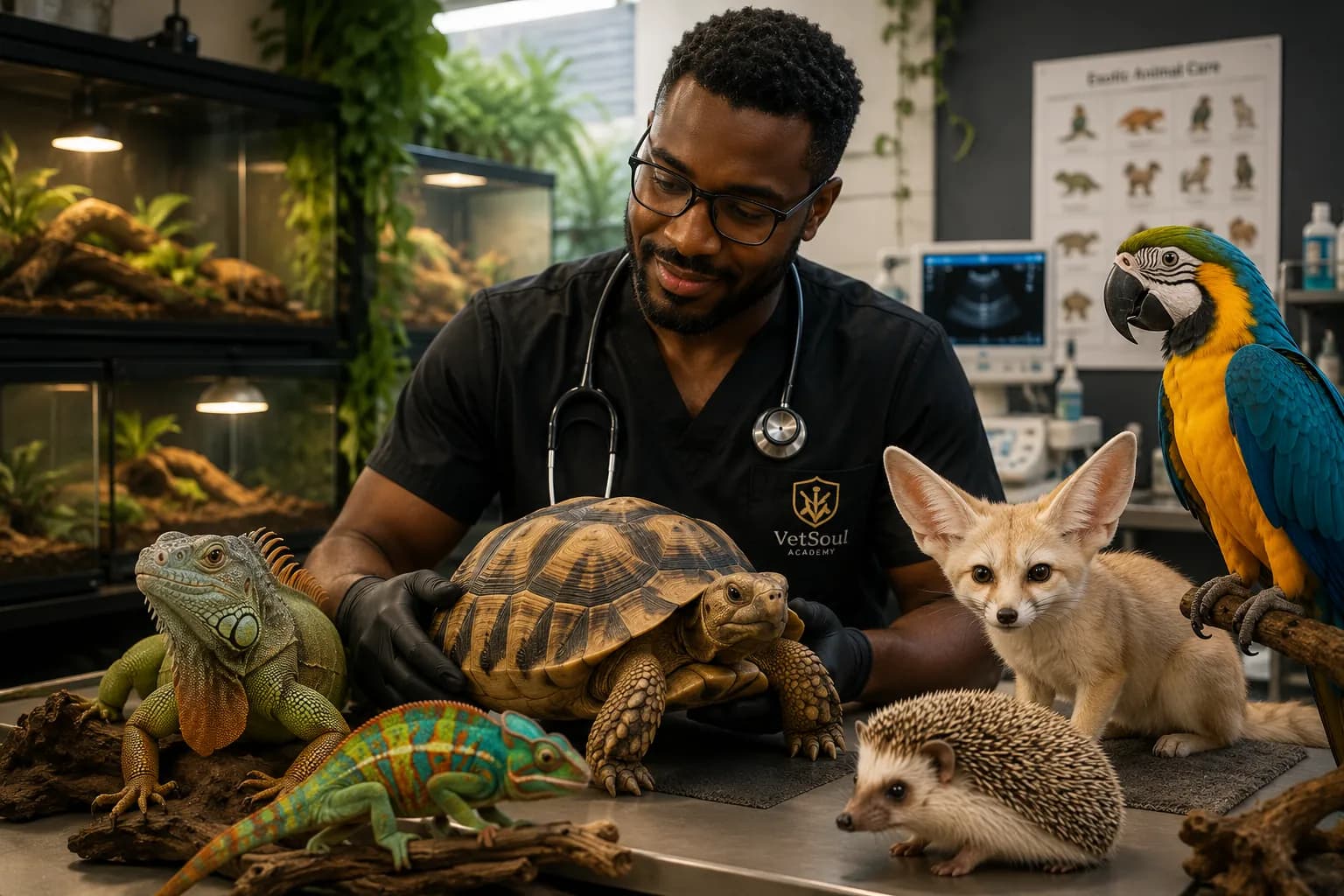
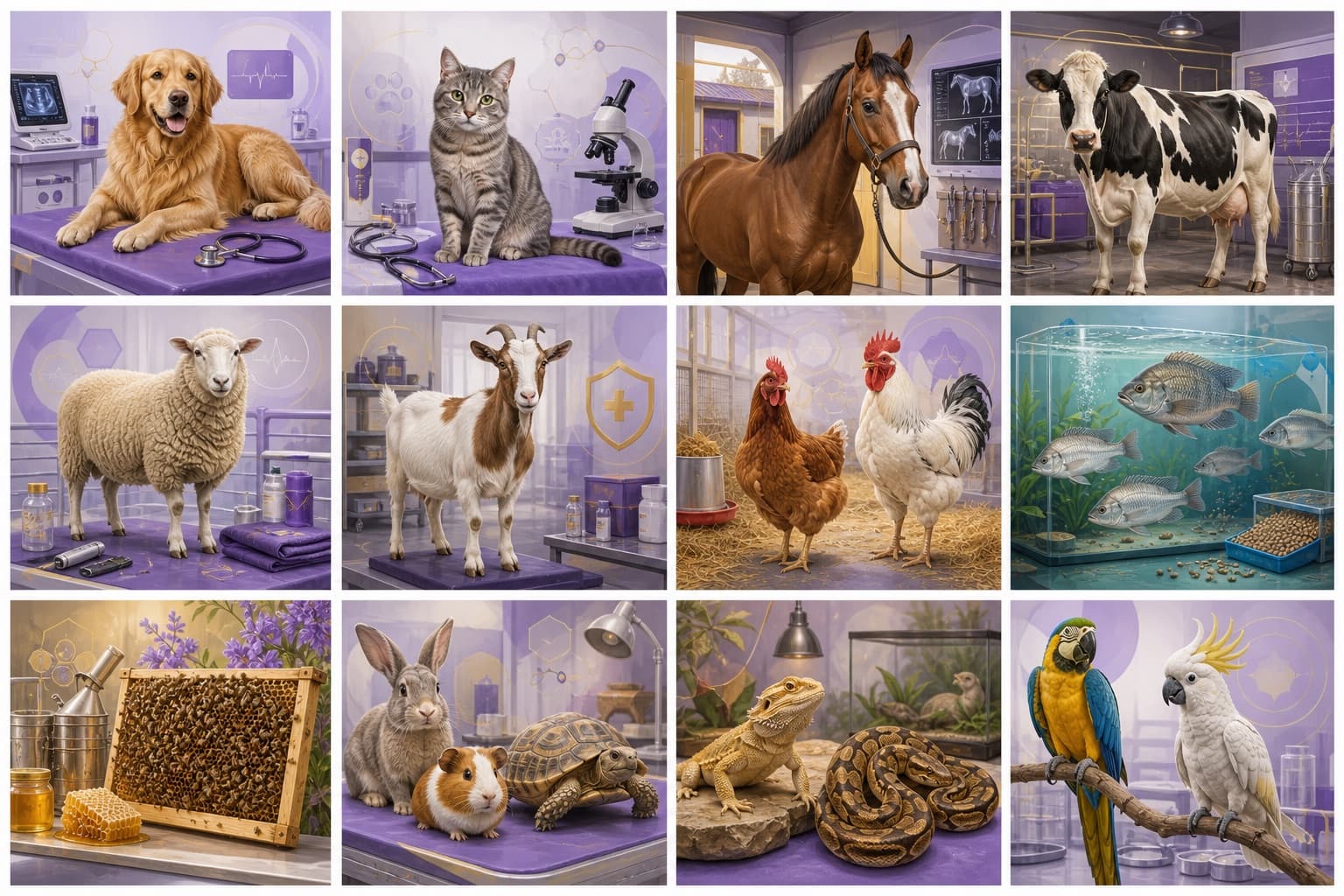
One set of principles for many extraordinary species.
Exotic collections span very different animals, but the fundamentals travel: specialized husbandry, environmental control, nutrition, behavior and welfare, safe handling, biosecurity, and knowing when a case belongs with a qualified exotic-animal veterinarian. This umbrella hub teaches those cross-species principles — for owners, sanctuaries, rescues, educators, students, and veterinary teams — and points to our dedicated Reptiles, Amphibians, Exotic Birds, and New Companion Animals academies for species-specific depth.
All numbers are computed from the live course catalog — nothing is estimated or invented.
Learning domains
Ten cross-species domains, one honest status system
Published curricula show their real module and lesson-plan counts. Nothing is marked available until real lessons exist — no invented ratings, student counts, or completion data.
Curriculum readyComing soon
Curriculum readyCertification
Exotic Animal Health & Disease Prevention
A prevention-first course for building health baselines across diverse exotic animal collections, recognising disease warning signs early, and knowing when a case belongs with a qualified exotic-animal veterinarian.
A practical course on species-appropriate nutrition and feeding safety across exotic animal collections, from diet categories and supplementation to storage, live-food safety, and nutrition-related disease prevention.
A specialised husbandry course on designing and managing enclosures and environments across exotic animal collections — temperature, humidity, lighting, ventilation, space, and enrichment tuned to each species' needs.
A welfare-centred course on reading exotic animal behaviour, assessing welfare, and applying low-stress, safe restraint and handling that protects both the animal and the handler across diverse species.
Biosecurity, Quarantine & Responsible Exotic Animal Care
A responsibility-first course on protecting exotic animal collections and people through quarantine and biosecurity, understanding zoonotic risk, and meeting the legal and ethical obligations of keeping exotic animals.
A calm, practical first-aid course for recognising emergencies across exotic animal collections, stabilising safely, and communicating clearly with qualified exotic-animal veterinary support.
Every Exotic Animals Academy pathway follows the same practical arc, so learners always know where a lesson sits and where their own responsibility ends.
1
Species research foundations
Before acquisition: natural history, legal status, space, lifespan, and whether a species can truly be met — the honest first question in exotic keeping.
2
Environment & husbandry
Enclosure design, temperature, humidity, lighting, ventilation, and enrichment — the measurable environment that keeps an exotic animal well.
3
Prevention & biosecurity
Quarantine of new animals, hygiene, zoonotic-risk awareness, and biosecurity that protects the collection and the people around it.
4
Observation & welfare
Structured checks and welfare assessment: appetite, behavior, weight, and records that reveal change early in species that mask illness.
5
When to seek veterinary care
Not eating, breathing distress, trauma, collapse, or sudden behavior change — thresholds where the right decision is a qualified exotic-animal veterinarian.
Veterinary tools
Exotic animal tools, built with veterinary review
Practical tools are being built alongside the curricula — and they will only ship after veterinary review. No formula on VetSoul will ever be published unverified.
Coming soon
Environment & parameter log
Structured records — temperature, humidity, lighting, and ventilation — with trend visibility across a collection.
Quarantine & biosecurity calendar
New-animal quarantine timelines and disinfection checkpoints before introduction to the wider collection.
Feeding & supplementation worksheet
Species-appropriate feeding and supplementation support connected to the Exotic Animal Nutrition & Feeding curriculum.
VetGPT Coach is an educational assistant, not a diagnosis engine. In exotic-animal mode it supports safer questions, husbandry and biosecurity planning, and course review — and always keeps your qualified exotic-animal veterinarian in the loop.
Species-aware study prompts for exotic animal health, husbandry, and nutrition
Prevention, quarantine, and biosecurity planning across a mixed collection
Red-flag literacy: not eating, breathing distress, trauma, and collapse thresholds, education only
Course review support connected to Exotic Animals Academy curricula
Emergency language — not eating, breathing distress, trauma, collapse — always redirects to a qualified exotic-animal veterinarian, and zoonotic and legal risks to safe hygiene, biosecurity, and compliance.
Course-aware
Prompts connect to the published Exotic Animals Academy curricula.
Cross-species
Umbrella husbandry, welfare, and biosecurity principles — and a pointer to the dedicated species academies for depth.
Responsible keeping
Cross-species care with responsibility before acquisition
The Exotic Animals Academy treats exotic keeping as a responsibility, not an impulse. Two certification-tier curricula anchor the responsible-care arc — from health and disease prevention to biosecurity, legal and ethical obligations, and welfare-first decisions.
Welfare first
Every decision starts with whether a species' physical and behavioral needs can genuinely be met in captivity.
Species research before acquisition
Natural history, lifespan, space, diet, and legal status understood before an animal is ever acquired.
Biosecurity & quarantine
Quarantine of new animals and biosecurity between species protect the whole collection from disease introduction.
Zoonotic-risk awareness
Understanding disease shared between animals and people, with hygiene and safe-contact practice for at-risk households.
Legal & ethical compliance
Permits, sourcing, captive-bred considerations, transparent records, and never releasing exotics to the wild.
Lifelong commitment
Realistic planning for cost, specialist veterinary access, and responsible rehoming or end-of-life care.
No. Every curriculum teaches observation, prevention, and preparation so you can act earlier and communicate better — examination, diagnosis, and treatment always belong to a licensed veterinarian, ideally one experienced with exotic animals.
Education, not diagnosis — and species-specific care always
Exotic Animals Academy content teaches observation, prevention, and preparation across many species. It never replaces examination, diagnosis, or treatment by a licensed veterinarian, ideally one experienced with exotic animals. This umbrella hub teaches cross-species principles and does not replace the species-specific depth of the dedicated Reptiles, Amphibians, Exotic Birds, and New Companion Animals academies — never generalise a diet, temperature, or handling method across species without checking that species' needs. Exotic animals often mask illness and can deteriorate quickly, so refusal to eat, breathing distress, trauma, collapse, or sudden behavior change warrants prompt care from a qualified exotic-animal veterinarian. Many exotic species can carry zoonotic diseases; follow hygiene, quarantine, and biosecurity practices, respect all legal and permit requirements, and never release captive exotic animals to the wild.